Fit-Out Strategies for Thailand’s Growing Co-Working and Flexible Office Sector
Building a successful co-working space in Thailand is not merely about renting a floor and installing desks. In a market as competitive as Thailand—where aesthetics, comfort, and technological integration are paramount—the quality of your fit-out can be the difference between a fully leased vibrant community and an empty, echoing hall.
Having performed fit-out work for a variety of businesses, facilities, and non-commercial organisations for nearly 40 years, we know what a transformative interior fit-out needs.
We’ve rendered interior fit-out services for offices across Asia. With this knowledge of creating productive, energising, and aesthetically pleasing spaces for employees, we’ve written this guide and adopted it for the co-working, flexible office sector.
Key Takeaways
- An interior fit-out transforms a shell-and-core space into a move-in-ready workspace.
- Effective co-working spaces require clear spatial zoning to accommodate the range of purposes and work types people come to a co-working space for.
- High-density infrastructure, including robust HVAC systems and accessible power, is essential to accommodate co-working occupancy.
- Acoustic engineering is critical for maintaining productivity and keeping distractions at bay in a shared, busy environment.
- Investing in a well-designed interior fit-out for your co-working space drives ROI through lower energy costs and higher member retention.
What is a Fit-Out?
A fit-out is the process of making an interior space suitable for occupation. When a developer completes a commercial building, the internal space is often left as a shell-and-core—a blank canvas.
A fit-out transforms this skeleton into a functional environment.
In the context of the office sector, fit-outs are generally categorised into two types:
- Category A (Cat A): This involves basic interior finishing. It includes raised floors, suspended ceilings, basic mechanical and electrical services, and fire safety systems. It provides a functional but neutral space.
- Category B (Cat B): A Cat B fit-out involves everything that makes an office move-in ready, customising the space to meet the business’s specific needs. It includes installing partitions, furniture, branding elements, IT infrastructure, and non-standard installations, such as an indoor bar.
The fit-out is a strategic investment. It dictates how people move through the space, how they use it for their productivity, and how they feel.
What Co-Working and Flexible Offices’ Fit-Outs Need
A co-working space is both a business and a social space. It should provide the amenities you’d typically see in a corporate office, such as WiFi, projectors, work desks, and a pantry, but also be curated to foster productivity and socialisation—like what you’d see in a coffee shop.
As such, a co-working space interior fit-out should satisfy three things:
Spatial Zoning
Spatial zoning is the strategic organisation of a floor plan into distinct activity zones. This means creating distinct zones that serve different purposes and are optimised for different user intents.
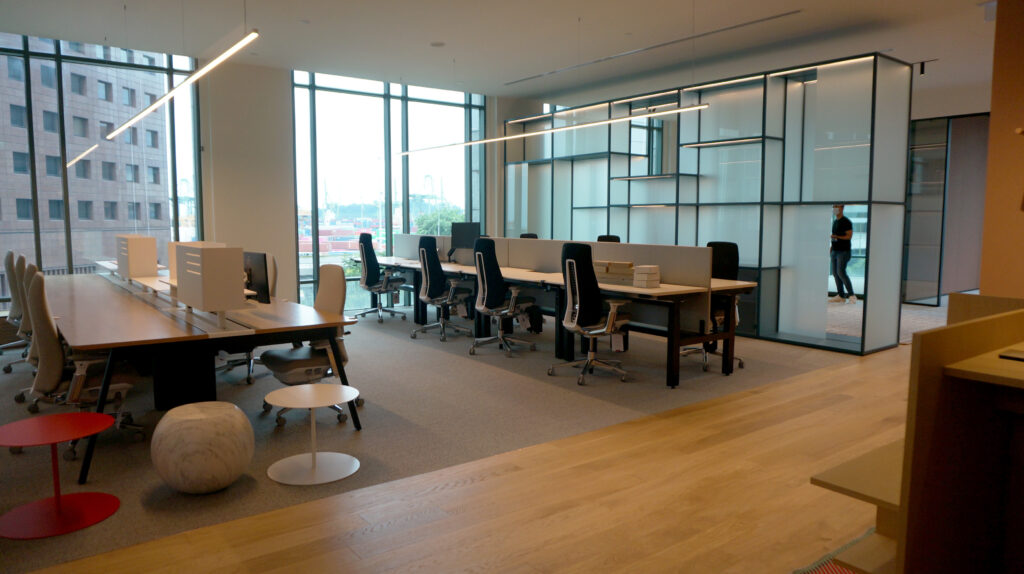
Notice how the lounge area shown above is zoned off from the communal desks and tables through the colour and the carpet.
Examples of zones your co-working space should have include:
- Desks that serve as zones for individuals
- Collaborative spaces that serve as zones for organisations
- Private offices for teams
- Dedicated meeting rooms outfitted with projectors
- Dedicated socialisation zones.
This allows a co-working space to serve multiple purposes and meet each customer’s distinct needs. By zoning the co-working space, users can get their work done effectively without distractions, which is the intended use of a co-working space in the first place.
High-Density Infrastructure
The space should be fitted out to accommodate more people than the standard corporate office.
With a corporate office, you have a static and expected number of people coming into the space. Whereas with a co-working space, you can’t predict how many people you’ll have at any given time, not to mention the unannounced walk-ins.
Because of this, a co-working space fit-out requires the following implementations:
- Improved HVAC. High-density zones require robust HVAC systems to counteract body heat and the CO2 within a room. More people mean more heat and CO2.
- Electrical Distribution. Every single seat needs power. Expect every customer to bring their own laptop.
- IT Infrastructure. Your WiFi should be able to accommodate your usual user capacity, so that neither of them experiences any slowdown.
Aesthetics and Branding

The fit-out is the physical manifestation of the brand. Your co-working space fit-out should align with the brand and provide a warm, inviting, and productive environment for users.
An office’s interior design promotes productivity and socialisation.
People’s moods and psychology are influenced by how a space looks. If the atmosphere is cramped and non-invigorating, then it doesn’t serve its co-working purpose. If the lighting isn’t bright enough, people will be lazy, and the co-working space environment will be influenced by the inadvertent afternoon vibe created by the unoptimal lighting.
Furthermore, your brand should be evident—reinforced through the interior design elements of the interior fit-out. This makes brand recall more effective, nudging workers to come back.
Fit-Out Strategies for a Modern Co-Working Space
Here are the core strategies for a high-performance fit-out that enables users to focus, collaborate, and thrive.
Acoustic Engineering
When you place a collaborative space next to the individual desks, a coder who needs silence won’t have a very work-conducive experience, even with headphones on.
Modern fit-outs solve this through acoustic engineering. These solutions isolate sound in the areas where they are needed, so they don’t bleed into other rooms and distract other deeply focused customers.
Examples of acoustic engineering implementations include:
- Baffle Ceilings: Hanging vertical panels that break up sound waves.
- Acoustic Wall Panels: Fabric-wrapped foam or recycled PET panels that absorb echoes.
- Glass Partitions: Favoured by offices, glass partitions provide a meeting room with sound privacy.
- Plants and greenery. Unlike hard concrete that reflects sound back into the room (creating echoes), plant leaves are porous, allowing them to absorb sound.
Zoned HVAC (Heating, Ventilation, and Air Conditioning)
A zoned HVAC strategy uses Variable Refrigerant Flow (VRF) systems or smart dampers to direct cooling only where it is needed.
For example, if a 10-person meeting room gets too hot, its specific VAV box opens wider to let in more cold air. Meanwhile, the VAV box for an empty zone might stay nearly closed to save energy.
This granular level of control ensures that a crowded meeting room stays cool and conducive for brainstorming while a sparsely populated lounge doesn’t become a refrigerator. Furthermore, it also drastically reduces operational energy costs.
Hot Desks and Power Accessibility
A common pitfall in office design is a lack of power outlets. A strategic fit-out accounts for how users will utilise the space and will plan outlet placement accordingly.
Power sources you’d want to have around the co-working space include:
- Wall Outlets: In a collaborative co-working space, you can’t have enough wall outlets. In the meeting room alone, the TV and projector need wall outlets, and so do the meeting attendees.
- Floor Boxes: These are hidden outlets beneath the floor, providing power to island desks that are nowhere near a wall.
- Desktop Integrated Power: These are USB-C and international power sockets built directly into the tabletops.
Kitchen, Cafe, or Pantry
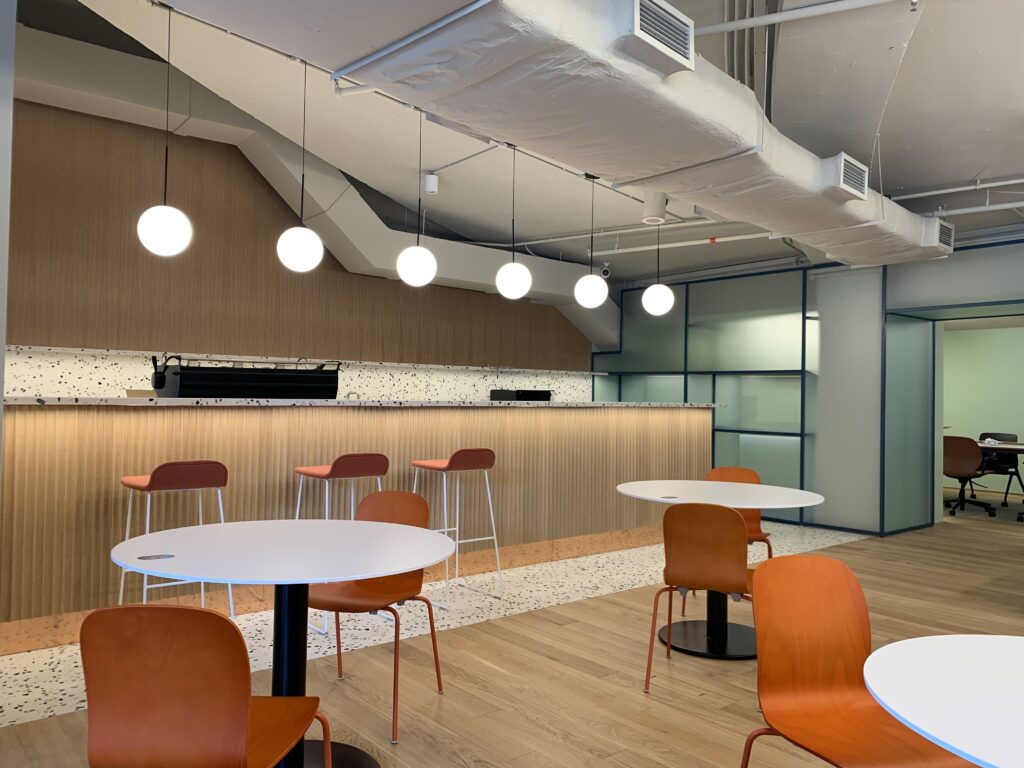
The pantry is the heart of the modern co-working space. It is no longer just a place to store a lunchbox. It is the social engine of the entire business model.
Unlike a private office where you might sit at your desk all day, the pantry is a shared destination. It is where a freelance graphic designer could bump into a startup founder while waiting for the espresso machine.
While the desks provide utility, the pantry offers the much-needed socialisation and networking that professionals seek in their careers. These social areas are the entire value that some co-working subscribers find in a co-working space.
Bright, Productive Lighting
Lighting design in a fit-out is about more than just visibility; it’s about circadian rhythms. A high-end fit-out will utilise:
- Ambient Lighting: This is the base level of illumination to ensure a space is safe and navigable. In offices and co-working spaces, ambient lighting is usually set to a cool, daytime temperature to invigorate occupants.
- Task Lighting: This illumination is directed at specific work surfaces to reduce eye strain during activities like reading or typing. These could be individual desk lamps so users can see their paper documents more clearly, or kitchen lighting so people can see what they’re pulling out of the cupboards.
- Accent Lighting: A decorative layer used to draw attention to architectural features or artwork, creating visual interest. In a co-working space fit-out, LED strips or neon are usually used to highlight interior design features and branding elements.
Aesthetic Strategy
While functionality is the foundation, the look and feel create the atmosphere, ambience, and culture of the space.
Adopt an On-Brand Colour Scheme
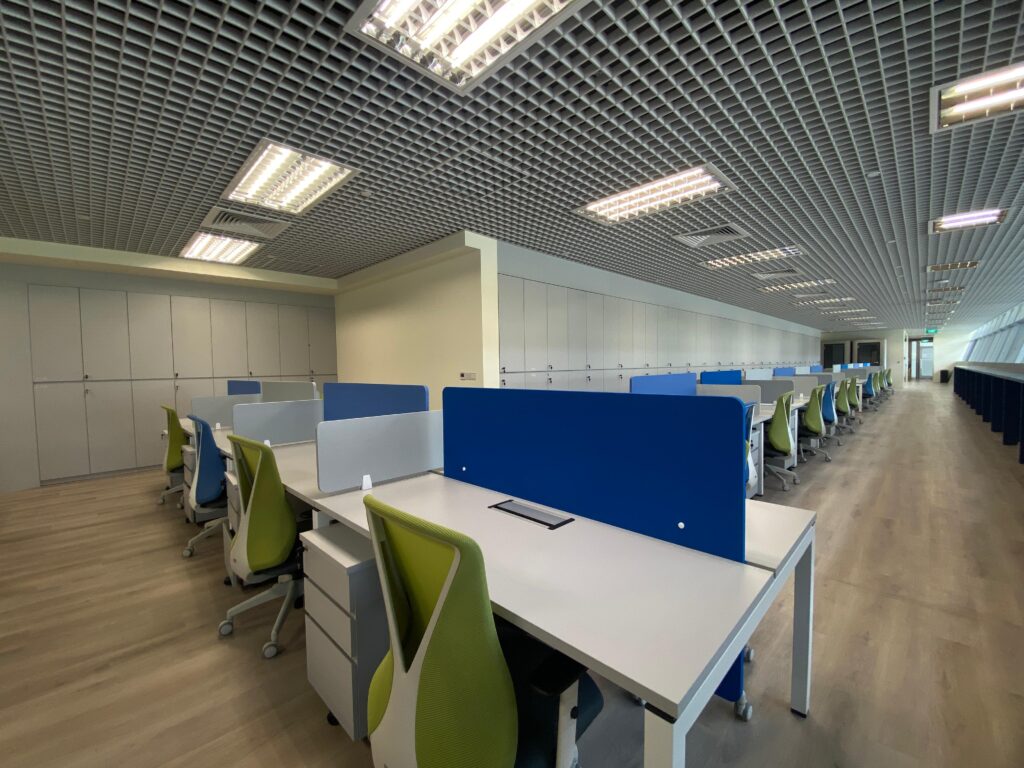
Your colour palette communicates your brand’s vibe.
Adopting an on-brand colour scheme is the foundation of your aesthetic strategy, ensuring that the physical environment aligns with your brand’s values and also curates a productive work environment.
Colours dictate how members feel the moment they walk in. Blues and greens foster calmness, whereas yellows and oranges jolt and energise workers.
Beyond beauty, colour is a functional tool. You can use hues to zone your space without physical barriers. For example, you might use warm lighting for the co-working space’s pantry, but daylight colour lighting for the general office area.
Furthermore, a co-working space is often a backdrop for Instagram posts and social media images. A distinctive, on-brand colour scheme makes your space instantly recognisable in social media posts, turning your physical fit-out into a passive marketing engine.
Abide by an Interior Design Style
Consistency is key. A fit-out should stick to a defined style, or at least, provide a seamless transition between styles. That way, the office doesn’t clash and clutter, which can overwhelm already-busy occupants.
Some interior design ideas that you can utilise for your co-working space include:
- Industrial Chic: Features exposed brick, visible ductwork, polished concrete floors, and black metal. They communicate a raw, grunginess layered with a modern touch.
- Biophilic Modernism: Uses living green walls, wood tones (such as oak or ash), and natural light to evoke a sense of warmth and nature.
- Mid-Century Modern: Uses iconic furniture silhouettes characterised by tapered legs and curves, warm walnut woods, and pops of mustard or teal, evoking eccentricity and creativity.
- Scandinavian Minimalism (Scandi): Introduces a rustic warmth through neutral palettes and soft textures like felt and wool. It evokes a homey feel in an otherwise corporate setup.
- Corporate Luxury (Executive): Utilises premium materials like marble, brass accents, and dark leather. It evokes luxury and high-end, giving members a sense of premium value.
Utilise Biophilic Elements
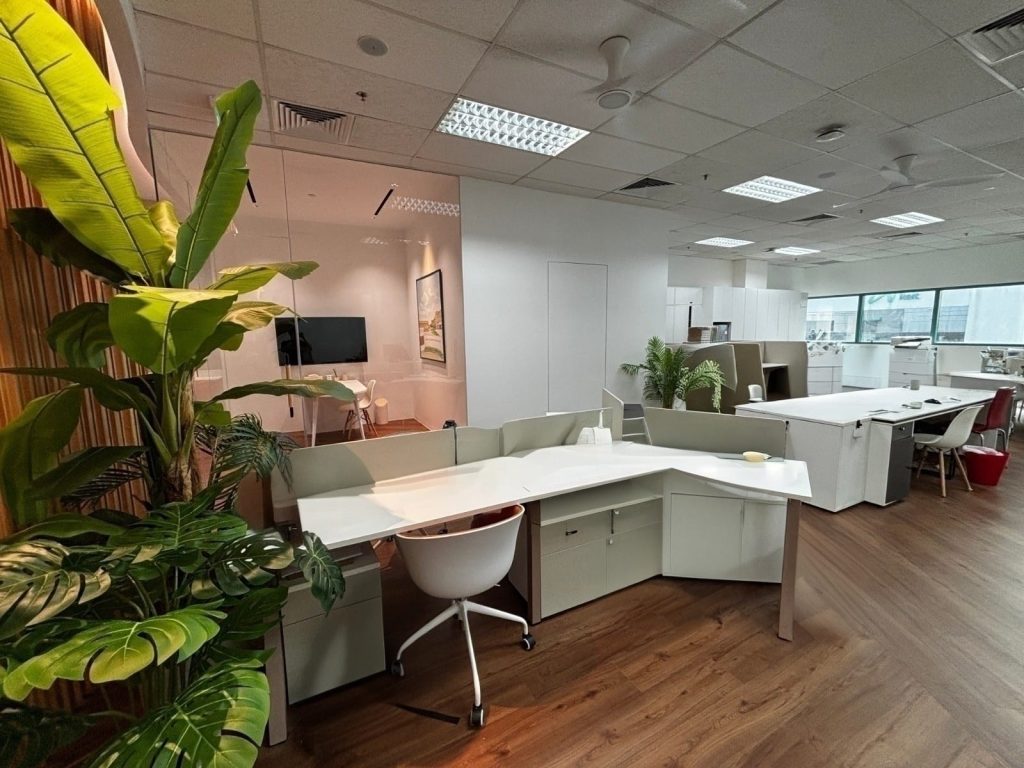
Biophilic elements provide visual relief, breaking up the linear, often sterile geometry of office partitioning.
Leaf textures and varying shades of green add organic layers, making a Category B fit-out feel premium and lived-in rather than cold and institutional.
They are also core elements to many modern, nature-inspired interior design styles, such as Japandi and Scandinavian. For designs that don’t primarily focus on plants, such as Industrial, these plants still add a pop of colour and form, providing a nice contrast within the co-working space.
Some examples of biophilic elements include:
- Living Walls: Vertical gardens that purify the air and provide a stunning visual focal point.
- Natural Materials: Rattan, stone, and unpolished wood are elements you’d typically find on a refreshing nature walk.
- Hanging Canopies: Using trailing plants like Pothos or English Ivy suspended from exposed ceiling mesh or pipes can soften the industrial look of the slab.
Embrace Glass Partitions
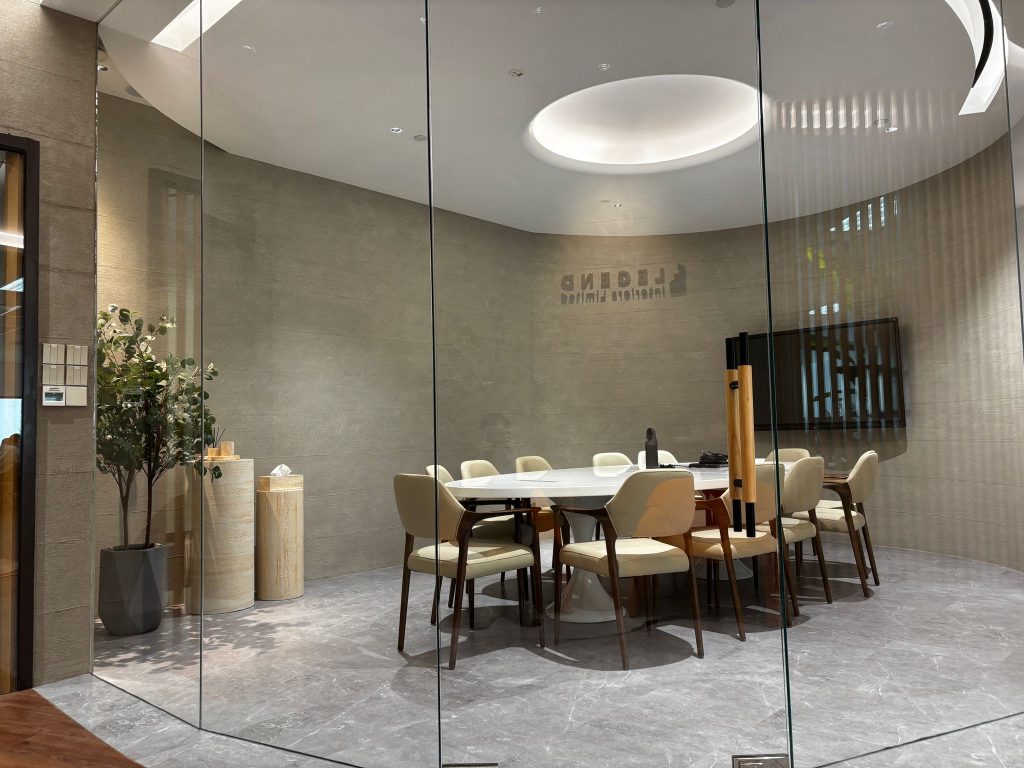
From an aesthetic strategy standpoint, glass divides a large floor plate into functional zones without sacrificing the open feeling of the space.
It transforms a potentially dark, cellular office into a bright, cohesive environment that feels significantly larger than its actual square footage. This evokes a sense of collaboration, openness, and transparency.
In addition, glass partitions allow light from the perimeter windows to flow into the building’s core, creating a vibrant atmosphere. During the day, natural light can enter the co-working space. At night, it allows the city skyline to serve as a backdrop for the space.
Technological Implementations that a Co-Working Space Fit-Out Must Have
Technological implementations are also part of a co-working space’s fitout. Though they aren’t usually services provided by your fit-out contractor, they are still essentials that will complete the livability and functionality of a co-working space.
Here are some technological strategies for your co-working space interior fit-out.
Keyless Entry
In a high-volume, high-foot-traffic environment like a co-working space, you’d still want to maintain security. However, you’d also want to optimise the flow of people going in and out of your premises.
Keyless entry—usually managed via a smartphone app via Bluetooth or NFC—helps address this issue.
You don’t have to be physically present to accommodate a new member. You send a digital key to their phone, and they can let themselves in at 6 AM on a Monday without needing a staff member to meet them.
When a member cancels their subscription, you don’t have to chase them down to get a key back. You just revoke access in the dashboard, and their key disappears instantly.
CCTV
CCTV is a basic security necessity for both businesses and households. If anything goes awry within your premises—perhaps a laptop was stolen, or someone had been injured while filing a lawsuit against your co-working space—then you’ll have the footage that will be useful in the given scenario.
You’d want to consider CCTV placement before construction starts. This will allow builders to plan wire concealment solutions for power and data wires, which can be crucial for maintaining a consistent interior design style.
Projectors or TV Monitors in Meeting Rooms
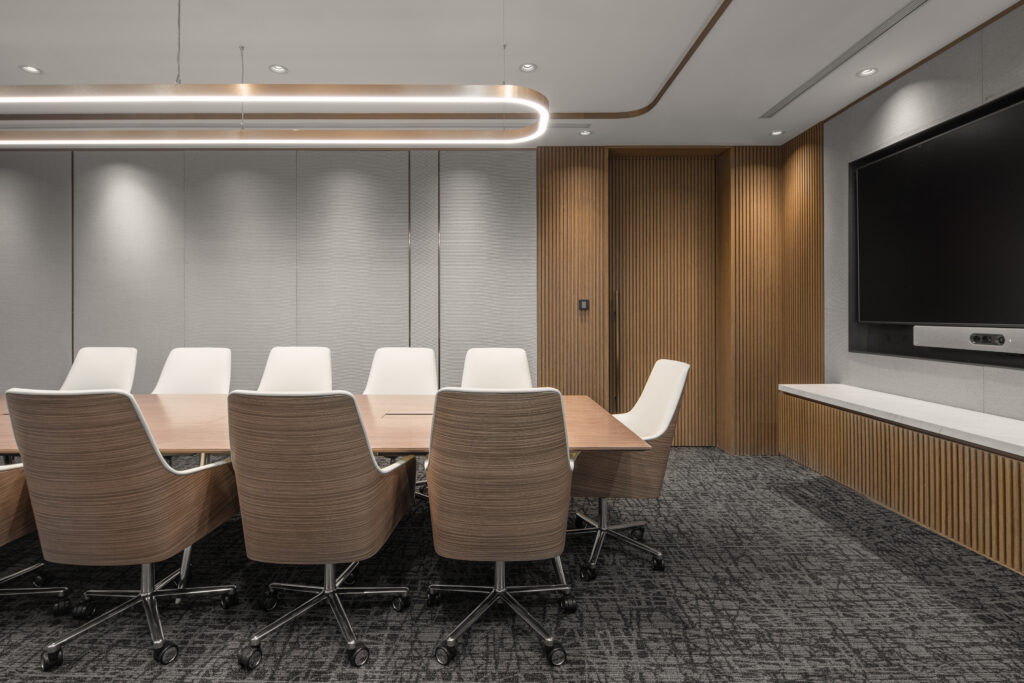
Having projectors or TVs in a meeting room allows teams to conduct PowerPoint presentations and convey ideas visually.
These function as collaborative tools, allowing teams to brainstorm and share ideas.
When not in use, TVs can be set to display a screensaver that reinforces the co-working space’s brand.
Internet Connectivity
Internet connection is as essential as electricity and air conditioning to a co-working space.
Your users need an internet connection to work, especially since they’re likely to be remote teams that need to communicate with other members. These teams also utilise browser-based apps to get work done.
However, for a busy co-working space, you can’t just use a typical home solution. You’d want to search for the following:
- Symmetrical Fiber and Redundancy: Most home internet is asymmetrical (fast downloads, slow uploads). A professional space requires a Symmetrical Gigabit Fiber line, ensuring that a member uploading a 4GB video file doesn’t lag the Zoom call of the person sitting next to them.
- Wi-Fi 6/7: These are the latest generations of wireless networking technology designed to handle high-density environments. By using multi-lane data processing (OFDMA and MLO), WiFi 6 and 7 provide faster speeds, lower latency, and more stable connections for dozens of devices simultaneously. This makes them the ideal option for co-working spaces.
- Ethernet Ports: Ethernet is a high-speed, wired networking technology that uses physical cables to connect computers and devices directly to a local network. This offers a more stable, faster connection than Wi-Fi, and is recommended for stationary desktop units and co-working desks.
The Thai Co-Working Market Context: Challenges and Opportunities
Fitting out a co-working space in Thailand comes with unique local considerations.
Condensation Management
Because of the extreme humidity, the interface between chilled air and glass/metal can cause condensation. A professional fit-out contractor ensures proper insulation of chilled water pipes and ductwork to prevent mold and water damage.
Permitting and Regulations
Thailand has specific building codes regarding fire egress, emergency lighting, and accessibility. Navigating these requirements requires a contractor who understands local municipal laws (TES – Thailand Engineering Standard).
Local Material Sourcing
Thailand has a rich industry of local furniture and material craftsmen. Integrating local materials can reduce the project’s carbon footprint and lower its costs.
The ROI of a Strategic Fit-Out
For a landlord or a co-working operator, the fit-out is the primary driver of its income. A well-executed space allows you to:
Brand Awareness
A well-executed interior fit-out reinforces the co-working space’s branding. This allows the co-working solution to better meet its marketing goals and improve customer retention and lifetime value.
Command Higher Rents
Tenants are willing to pay a premium for a space that is more conducive to work than one that lacks basic technological necessities. This allows you to justify higher subscription rates for your co-working services.
Increase Retention
Tenants are more likely to come back to co-working spaces where they feel productive and empowered, even if it costs more. This results in a steadier and more loyal user base.
Reduce Operational Costs
Smart HVAC and lighting systems pay for themselves over time through reduced utility bills.
Get in Touch with a Workplace Fit-Out Contractor for your Co-Working Office Today!
Legend Interiors is a premier fit-out specialist with a strong presence across Asia. We specialise in transforming commercial shells into high-performance, vibrant workspaces that align with your business needs. We provide the end-to-end fit-out solutions necessary to transform an empty space into a functional co-working environment that energises users.
Ready to elevate your workspace? Contact Legend Interiors today to discuss your Thailand fit-out requirements. Discover how a strategic interior strategy can transform your business.
Frequently Asked Questions
How long does a typical co-working fit-out take to complete in Thailand?
Depending on the size of the floor plate and the complexity of the Cat B requirements, most projects take between 8 and 16 weeks from design approval to final handover.
What is the average cost per square meter for a premium fit-out?
While costs vary based on material choices, a high-end flexible office fit-out in Thailand typically ranges from 25,000 to 45,000 THB per square meter.
Can I reuse existing furniture from a previous tenant to save costs?
You can, but it is often better to upcycle or reupholster items to match your specific branding, as mismatched furniture can limit the premium feel and brand consistency of the co-working space.
How do I choose between a centralised and a decentralised AC system?
For co-working spaces, a VRF (Variable Refrigerant Flow) system is usually preferred over a central chiller because it allows you to cool specific zones independently, saving money when the space is only partially occupied.
Does the fit-out contractor handle the application for utility meters?
Most fit-out contractors in Thailand will coordinate with building management and local authorities (MEA/PWA) to ensure power and water meters are correctly installed and rated for high-density use.